


LEVEL 11/4
CALIBRATION
Get an honest baseline.
The first month puts on paper how you shoot today: your hits, your pace and the zones you find. The next three build on that baseline.
Defensive skill is built one range day at a time.
Defensive pistol training is practice for one job: protecting yourself and your family with a handgun. NES turns it into 4 months of planned sessions at the range you choose, each with its own printed plan, its own targets and a standard you check on paper. 4 months, 2 or 3 range sessions every month. From $299.
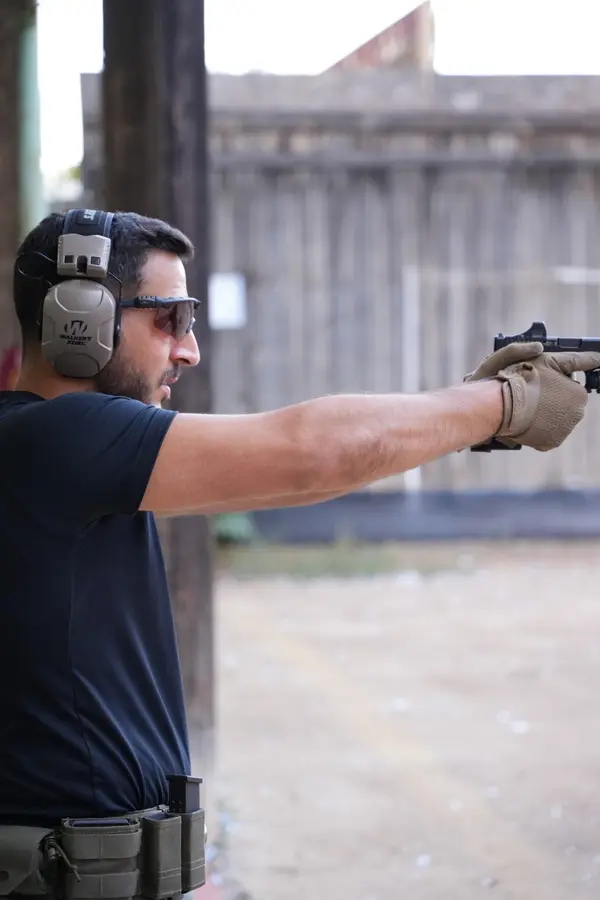
A good class teaches the skills in days. Keeping them takes months.
Many defensive pistol courses run one day: about 8 hours and a few hundred rounds, with an instructor correcting you as you go. That is the right way to learn a defensive skill. It is not enough to keep one.
Speed with accuracy, pairs that stay in the zone, a clean switch to a second target: these are perishable skills. An ordinary range trip doesn’t keep them sharp, because it has one target, a comfortable pace and no plan.
What keeps defensive shooting skills is practice with a plan: the same skills, measured on targets built for them, with the bar raised one level at a time.
That is what NES adds around a class: 4 months of planned range sessions, 2 or 3 every month, each with its own plan, its own targets and a standard to meet. It doesn’t replace the class. It is the practice that comes after it.
Defensive handgun training is shooting skill plus judgment. Put the official outlines of the NRA Defensive Pistol course, the USCCA Defensive Pistol Program and Gunsite’s 250 Defensive Pistol side by side, and between them they cover these ten skills. We read all three on .
The safety rules applied to the pistol you carry: loading, unloading, holstering and carrying, not only at a relaxed bench.
Grip, sights and trigger press that still hold up when you go faster. The USCCA calls it the balance of speed and precision.
Getting the pistol from the holster, often from under a cover garment, onto the target safely. Taught hands-on in class.
Pairs and strings to the body, and a precise shot to the head when it is needed.
Moving your eyes and your muzzle to the next target without giving up your hits.
Processing what is in front of you before you fire, and choosing which target to engage first.
An empty magazine or a malfunction cleared fast, so the pistol keeps working.
Knowing what stops a bullet and what only hides you from view.
Finding and identifying a target in the dark, usually with a flashlight.
Levels of mental awareness, and the mindset to use a pistol for protection ethically and responsibly.
Most of the shooting you can practice alone, with a plan. Four things need a live instructor: force on force, low light, the law on using force, and learning holster work under coaching. Movement, cover and stoppages belong in a class too.
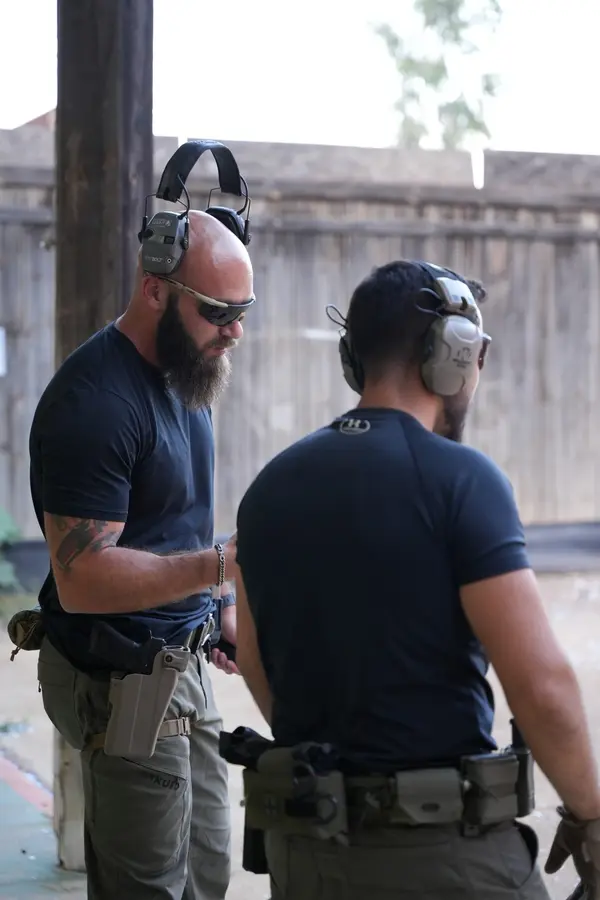
Our advice: take at least one defensive pistol class with a live instructor, then train on a plan. NES is the plan. It doesn’t replace the class, and it gives no certificate.
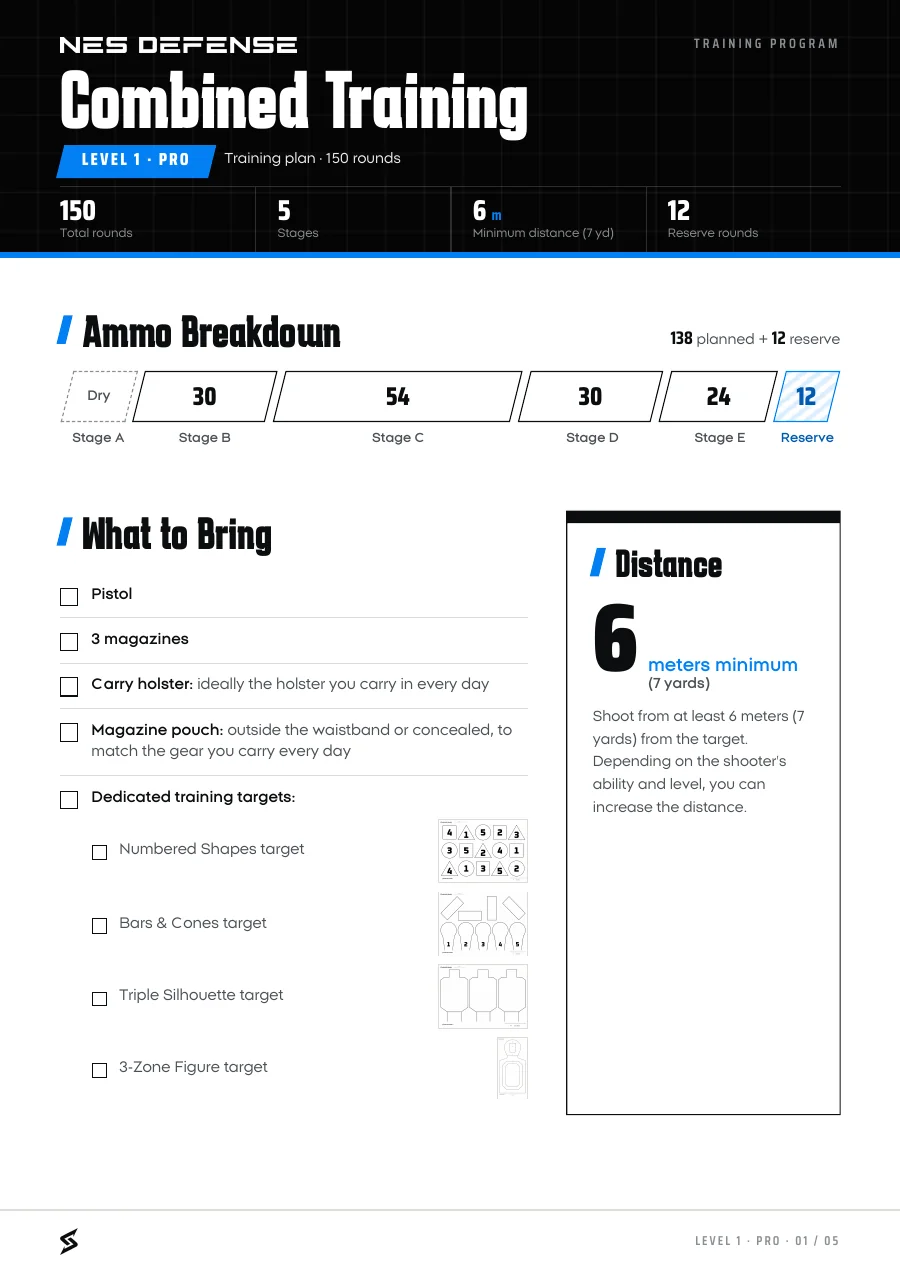
Each skill you can train alone maps to a stage of the LEVEL 1 plans, and each stage names its target, its round count and the zones you fire into. The minimum distance is 6 meters (7 yards), and you can move back as your level allows. Combat and combined sessions are shot from concealment, under the clothing you normally carry in.
Technical session, every track: the Circles target, then Bars & Cones
Dry reps come first, 5 to 15 of each drill. Live, you press only on a full sight picture, and on the bars the plan sets its standard: 3 hits inside the edges of each bar.
86 rounds
Combat session, every track: 3-Zone Figure
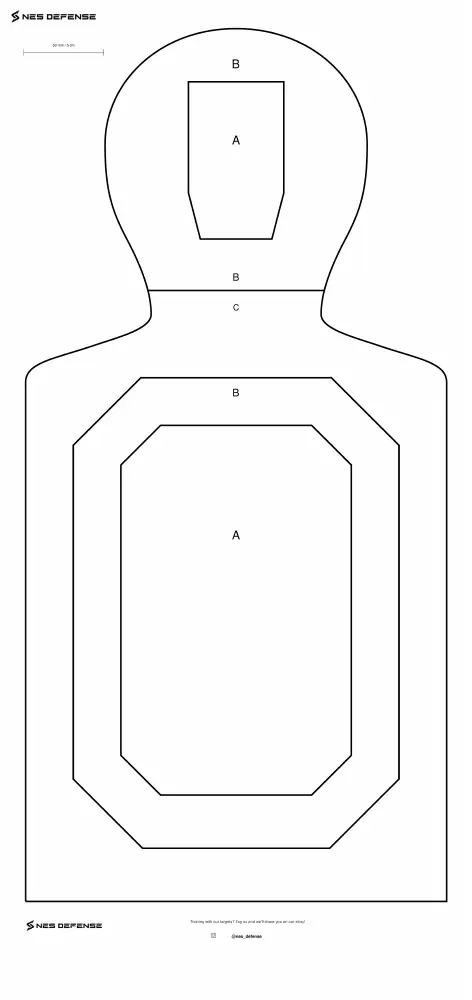
On the start signal, 3 rounds into the body's A zone and 2 into the head's, once with each of three 5-round magazines, pushing the pace on each one as long as the hits stay effective. The whole stage runs twice.
30 rounds
Combat session, every track: 3-Zone Figure
One 10-round magazine per run: fast fire to the body for 4 to 7 rounds, then slower, precise fire to the head until it is empty. Run it twice.
20 rounds
Combat session, every track: Numbered Circles
Three magazines of 5, 8 and 7 rounds, each emptied in one string. Top row: 1 round on each circle. Middle row: 2 on each. Bottom row: the number printed on each circle. The stage runs twice.
40 rounds
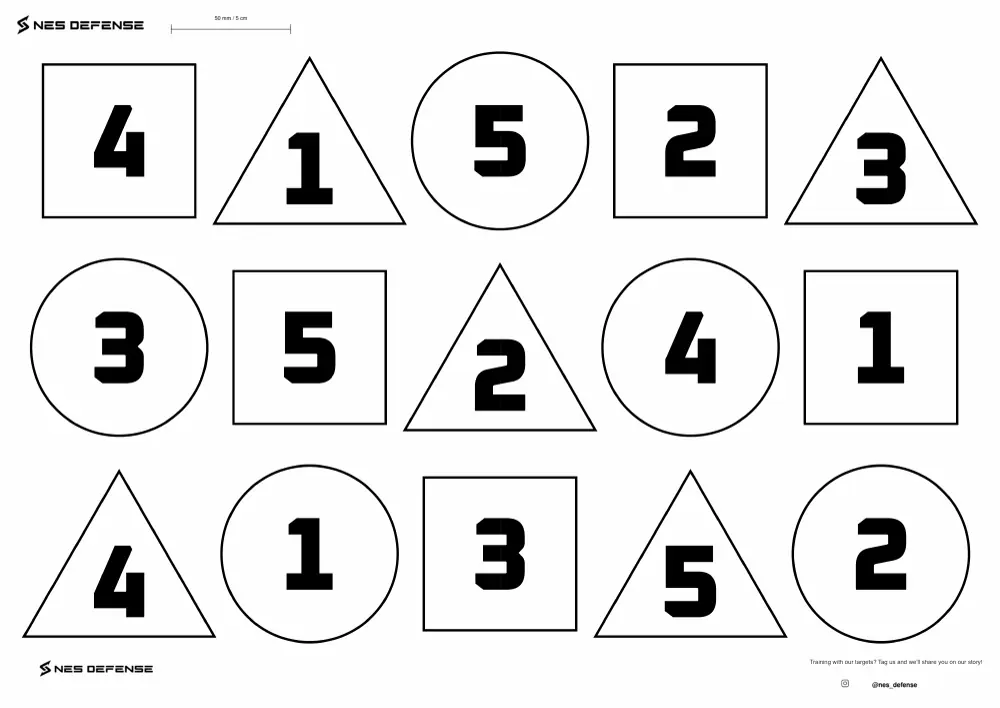
Combined session, PRO and DIAMOND: Numbered Shapes
Every start signal comes with a call (one shape, one number), and that shape alone gets your 1 round. Training alone, you list the calls in random order on a small card before you start. Two 15-round magazines.
30 rounds
Combined session, PRO and DIAMOND: Triple Silhouette
On one silhouette: 5 rounds, return to close ready, and 5 more when the next start signal comes. PRO uses three 10-round magazines. DIAMOND adds a third signal to each of two 15-round magazines.
30 rounds
Combat session, DIAMOND: Triple Silhouette
Three 15-round magazines with 5 rounds per silhouette, and a new order each time: right, left, center; then center, left, right; then left, center, right.
45 rounds
Every session, every track: reserve rounds
Every plan sets rounds aside for a string that went badly or was interrupted, so you can work a weak point again without eating into the rounds planned for the rest of the session.
10 to 20 rounds
The plans were written with Israeli special forces operators who have combat experience, and it shows in the structure: every live stage has its target, its round count and its firing zones, and every session holds reserve rounds for re-shoots. For more on how that method was adapted outside the military, see civilian tactical training.
Want to shoot one before you pick a track? The free pistol drills in our Academy are taken from these same plans.
Take a course for the coaching and the skills you can’t train alone. Use a program for the months around it. Here is what real defensive pistol courses list on their own pages, next to NES.
| Course | Length | Price | Live instructor | What it covers |
|---|---|---|---|---|
| NRA Defensive PistolNRA course descriptionChecked | Not listed by the NRA. One New Hampshire school lists about 4 hours in class, 4 on the range and at least 200 rounds. | Not listed by the NRA | Yes, an NRA certified instructor | Defensive mindset, concealment, cover versus concealment, drawing from the holster and clearing common stoppages. Ends with an NRA Defensive Pistol certificate. |
| USCCA Defensive Shooting FundamentalsOne class in Hempstead, Texas, on November 14, 2026Checked | 3 hours: 1 in class, 2 on the range | $135 | Yes, with coaching on the range | Defensive versus marksmanship shooting, grip, flash sight picture, trigger control and controlled cadence. |
| 1-Day Defensive Pistol Skills CourseSpartan Tactical, Downers Grove, IllinoisChecked | 1 day, 8 hours | $195, range fees and a loaner gun included | Yes, up to 14 students | Presentation from the holster, reloads, malfunction drills, threat assessment and use of force law, then a timed qualification. 250 rounds minimum, after one of the school's 2-day courses. |
| Defensive Pistol IApplied Defense Concepts, Norfolk, VirginiaChecked | 1 day | $275 | Yes | Cover and concealment, malfunctions, reloads, multiple targets, shooting positions and mindset. 300 rounds minimum, no prerequisite. |
| Defensive Pistol 101Critical Defense Institute, Concord, New HampshireChecked | 1 day, 8 hours | $295, guns and equipment provided | Yes | Safety, storage, carry law, use of force, stance, grip and trigger. The first of a 5-class series that adds force on force with Simunition gear and low light. |
| 250 Defensive PistolGunsite Academy, Paulden, ArizonaChecked | 5 days | $2,135 tuition, plus 1,000 rounds of ball and 50 frangible | Yes | Marksmanship, gun handling and mindset, low light and night shooting with flashlights, and live-fire simulators. No prerequisite. |
| NES DefenseThis program, at any range you choose | 4 months: 8 range sessions on CORE, 12 on PRO or DIAMOND | $299, $359 or $449 by track, covering the whole program, in up to 3 installments | No one at your lane. For the first month, the NES team is there for questions and corrections | Each live stage has its written steps, its own target and its firing zones, plus reserve rounds for re-shoots. No certificate, no force on force, no low light. |
Ideally, you do both: a class for the coaching and the instructor-only skills, then a written plan for each range trip that follows.
Four months, four levels, and one standard waiting at the end:

Get an honest baseline.
The first month puts on paper how you shoot today: your hits, your pace and the zones you find. The next three build on that baseline.
Do it again, and again.
One clean string can be luck. This month asks for the same result from the first magazine of a session to the last.
Ask more of the same skills.
The bar rises on the skills you built, and the targets show which ones keep up and which slip.
One performance, start to finish.
Fundamentals, zones, targets and decisions come together in the last month, which ends at the NES STANDARD.
Not as a subject. NES builds the shooting a home defender relies on, and stops there. Home defense training covers far more than shooting, so pair NES with a local home defense class.
Two places to start, checked on . The NRA’s Basic Personal Protection In The Home course is 8 hours with about 100 rounds, and its law lesson is taught by an attorney, a qualified police officer or someone the state certifies to teach that law. The USCCA’s Concealed Carry and Home Defense Fundamentals course covers a home protection plan and the legal use of force: one El Paso, Texas class on November 28, 2026 lists $150 for 6 hours in the classroom and 2 on the range. The USCCA also lists shorter home defense mini-classes, taught by its certified instructors.
PRO or DIAMOND. Both add the combined session, where you shoot on a call and start again on a new signal. CORE is where you build the fundamentals first.
$299
Up to 200 rounds · 2 sessions a month
Pick CORE to build the fundamentals first: a technical and a combat session every month. At LEVEL 1, the combat session works the body and head zones of the 3-Zone Figure.
$359
Up to 350 rounds · 3 sessions a month
Pick PRO for defensive training. It adds the combined session, which at LEVEL 1 means called shapes on the Numbered Shapes target, a fresh start signal on the Triple Silhouette and a faster pace on the 3-Zone Figure.
$449
Up to 500 rounds · 3 sessions a month
Pick DIAMOND for the most rounds and drills. At LEVEL 1, its combat session switches between all three silhouettes, and the Focus Squares target adds single presentations, each on its own signal.
PRO and DIAMOND are also our picks for tactical pistol training. Carrying daily? Our concealed carry training program walks through the same 4 months for people who carry.
Everything in the 4-month NES training program
4 levels that build on each other, with a clear printable plan for every session.
So every drill, every round and every metric is tied to a clear goal.
So you know where you stand, what improved and what comes next.
Where you download the training plans and targets for every stage of the program.
A note on language: the printable plans and targets are in English. Each session also has a short training video, and for now those videos are in Hebrew. English videos are on the way.
Want to try one first? The free NES Alpha target is one of the program’s own printable targets, free for your email address: print it and bring it to your next range session.
Plus 2 bonuses: a month of coaching support and NES MEMBER for life
up to200roundsper month
2 sessions a month · rounds per session
$299
One-time payment for all 4 months
*Split into up to 3 payments
up to350roundsper month
3 sessions a month · rounds per session
$359
One-time payment for all 4 months
*Split into up to 3 payments
up to500roundsper month
3 sessions a month · rounds per session
$449
One-time payment for all 4 months
*Split into up to 3 payments
+ 2 bonuses with every track: a month of coaching support • NES MEMBER for life
Every track leads to the same NES STANDARD. The difference is how many rounds and sessions you run each month.
Included in the price. Nothing extra to pay.
For the first month you are not left alone with the plan. The NES team is with you for questions, corrections and help along the way.
The moment you join a track, you are part of the NES community. NES MEMBER includes:
You are not just getting a 4-month training plan.
You are joining a system that stays with you long after the program ends.
4 months of training. A community for life.
Before you sign up: NES next to a class, the cost, starting as a beginner, gear, range rules and what is online.
No. A class puts a live instructor next to you and, depending on the course, teaches the law on using force, low light or force on force. NES has no one at your lane and gives no certificate. What NES adds is structured practice around a class: 4 months of range sessions, each with its plan, its targets and its standard. It is not a permit course either; for that, read what a CCW class covers.
In the listings we checked on October 31, 2026: $135 for a 3-hour USCCA class in Texas, $195 to $295 for one-day courses in Illinois, Virginia and New Hampshire, and $2,135 in tuition for Gunsite's five-day 250 in Arizona. Ammunition is usually extra. NES costs $299, $359 or $449 depending on the track, paid once for all 4 months or split into as many as 3 installments. Ammunition and range fees are yours to cover.
Yes: LEVEL 1 is there to set your baseline, wherever it is. If you have never shot a handgun at all, though, start with an in-person basic class, and know the four safety rules by heart before you go: treat every gun as loaded, never point it at anything you are not willing to destroy, keep your finger off the trigger until the sights are on target, and be sure of your target and of what lies beyond it. Our page on pistol training for beginners walks through a first-month technical session, stage by stage.
Yes. Every LEVEL 1 plan has the same packing list: your pistol, 3 magazines, a magazine pouch, a carry holster (ideally your everyday one) and the targets printed for that session. Pack eye and ear protection for every session. Combat and combined sessions are shot from concealment, so wear the cover garment you usually carry under. New to holster work? Learn it in person from a qualified instructor before you practice it alone.
Part of the program still works. On CORE and PRO, every live stage of the technical session starts from the ready position, not the holster. The combat and combined sessions need a lane that allows holster work and fast strings. Check with your range before you book, and never bend a range rule to finish a drill.
In part. The plan reaches you online: a member area with the printable plans and targets, plus a short video for every session, in Hebrew for now. Every round, though, is fired live at a range. On days between range sessions, dry fire at home can help, but only with the full safety protocol, start to finish: unload the pistol and confirm twice that it is empty; move all ammunition, loaded magazines included, to another room; aim only in a safe direction, at a backstop able to stop a bullet; let no live round into the session; and when you finish, say out loud that dry practice is over before you reload. The dry fire training guide in our Academy covers the whole routine.
At LEVEL 1 CALIBRATION. Pick the track that fits the rounds you fire each month, then print your first session’s plan and shoot your baseline. From then on, every session comes with its own target, round count and standard.
Still deciding? Shoot the free NES Alpha target first.