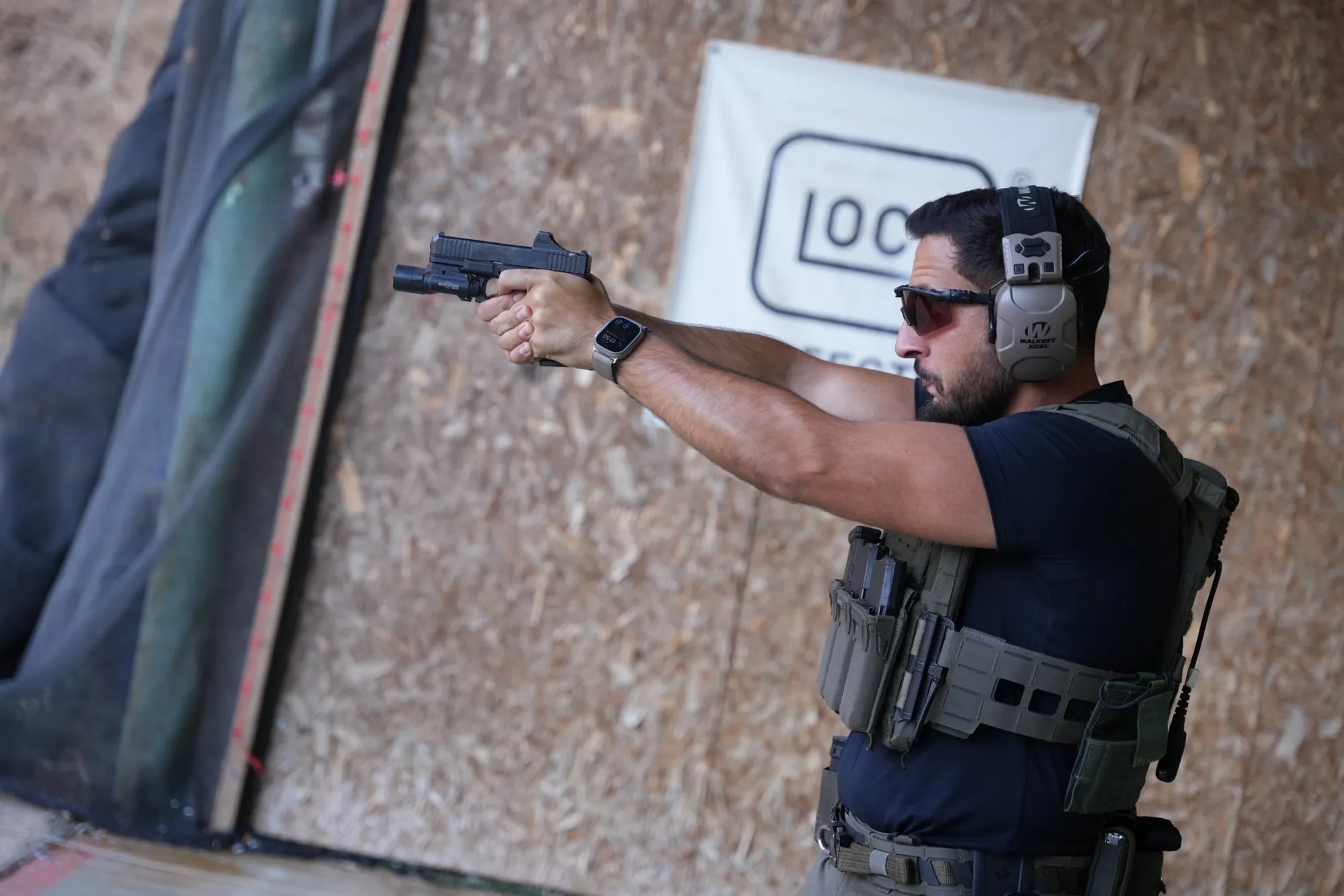
If it ever happens, it happens with the pistol you carry.
Civilian tactical trainingfor the armed citizen
For an armed citizen, civilian tactical training means the pistol skills you would need if it ever happens: working from concealment, under pressure, with decisions on the clock. NES is a 4-month program built with Israeli special forces operators that you run at your own range.4 levels in 4 months. One payment from $299.
What is civilian tactical training, and what is it not?
For a civilian, it is not a smaller copy of what soldiers do.
Search for civilian tactical training and you will find rifles, night vision, shoot houses and room clearing, most of it borrowed from military and police teams. An armed citizen’s version is narrower, and in a way harder: the pistol on your belt, the clothes you wear that day, and nobody beside you to call the targets.
Tactical, here, means decisions under pressure, not gear. Working from concealment. Firing only when your sights are on the right target. Hits that stay good as the pace goes up. Choosing, counting and shooting on a signal instead of at a relaxed pace.
What it is not: rifle work, team tactics, room clearing, or military tactical training for civilians who want a taste of the army. It is not a permit or CCW class either. NES leaves all of that out on purpose and trains one thing: the pistol you carry.
What should tactical training for civilians include?
Use this list to judge any provider, us included. There is no single best tactical training for civilians, but the training worth paying for has these seven things in common.
01
Your own carry setup, from concealment
The pistol, holster and cover garment you wear every day, because that is what you would have. Gear you never carry builds habits you can't use.
02
A decision before the shot
Drills where you read a call, pick a target or count your rounds before you fire. Fast hits on a target you already knew about are only half the job.
03
A standard you can pass or fail
Each drill should say what counts: hits inside a zone, a set number of rounds, a fixed order of targets. Without one, a good day and a bad day feel the same.
04
Slow before fast
The sequence rehearsed dry, then fired at a controlled pace, and only then pushed for speed. Speed on top of a skill you never built is just a faster mistake.
05
Months, not one weekend
A single class is a good start. Skill stays with practice that continues, so ask what you will train in the months after it.
06
Honest limits
A good provider tells you what it does not teach, what your range has to allow, and that shooting skills are not legal advice.
07
Live feedback and pressure
An instructor who watches you shoot sees errors you can't. Force on force, against a role player with training guns, adds pressure no paper target can.
How NES measures up, honestly: the first six are built into the program. The seventh it cannot give you. No instructor stands at your lane and there is no force on force. The first month does include coaching support from the NES team, for questions and corrections.
What does “built with Israeli special forces operators” mean here?
The NES programs were built together with Israeli special forces operators with combat experience. That is the claim, word for word, and we keep it that exact.
What it does not mean: that you will train beside them, that anyone from a unit watches your sessions, or that you are signing up for a military course. You run a civilian pistol program, on your own, at a range you choose.
What you will see in the plans is structure: dry reps before any live fire, every round planned with a reserve held back, strings fired on a start signal, and targets that make you decide before you shoot.
NES started in Israel, as a growing number of civilians there took up carrying a pistol, and the programs were written for working people with families, training at an ordinary range. The same method is now offered in the US, priced in dollars.
What are your options, and what do they cost?
Civilian tactical training courses come in four shapes: a weekend class, a multi-day academy course, private instruction, or a structured program you run yourself. In the real examples below, a two-day class lists about $500 in tuition, a five-day academy $2,135, and NES $299 to $449, one payment that covers the whole 4 months.
As each provider listed it on its own site. Ammunition is extra in every row, ours included.
NES Defense, this programBuilt with Israeli special forces operators; no instructor at your lane
4 months: 2 range sessions a month on CORE, 3 on PRO and DIAMOND
$299 CORE, $359 PRO or $449 DIAMOND for the 4 months, payable in up to 3 installments
Up to 200, 350 or 500 a month, by track
Your own range, if it allows the drills
Looking for Navy SEAL tactical training for civilians? Noir Training advertises instruction from U.S. Navy SEALs and Army Green Berets. It runs no open-enrollment classes, only private group and individual training, in Las Vegas, in Nashville or at your location. Its pricing page gives estimates per person, per day: at the Las Vegas and Nashville sites, one person for 4 hours is $1,250 with your own guns, ammunition and gear, or $1,650 all-inclusive (checked ). The final price comes as a quote.
A live course does four things better. An instructor watches every rep and fixes what you can’t see from behind the sights. Force on force puts you against a role player with training guns, which no paper target can copy. Scenario work, like the indoor and outdoor live-fire simulators in Gunsite’s 250, trains decisions in a setting a public range lane doesn’t offer. And low-light shooting, like the flashlight and night work in that same course, needs a range and instructors set up for the dark.
What NES does better is the months after. A weekend packs its rounds into two days, then ends. NES spreads them over 4 months and 2 or 3 sessions a month, each one planned, with its own targets and round count, at your usual range, and for less than the tuition of any course in the table. Over the 4 months that adds up to as many as 800, 1,400 or 2,000 rounds, depending on your track, so budget for the ammunition.
For many people, the strongest setup is both: a live class for coaching and pressure, then a structured plan for the range days that come after it.
How does NES turn that into 4 months of range sessions?
One level each month, with a printed plan for every range session. Your track sets the pace: CORE runs 2 sessions a month, PRO and DIAMOND run 3. Each session brings its own targets, its own round count and a reserve for re-shoots. This is what LEVEL 1 holds, from the English plans.
Technical session
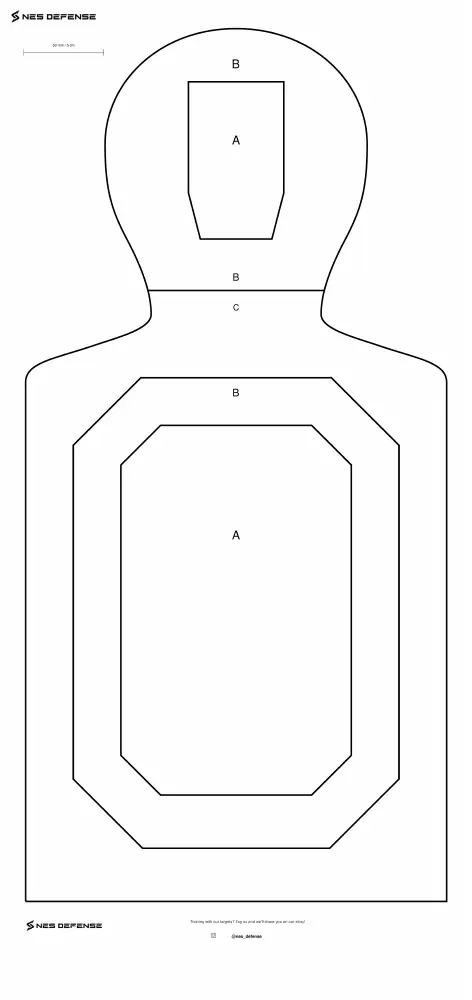
The fundamentals under control: grip, hands together, presentation, sight picture and fire control, rehearsed dry and then fired on the Circles and Bars & Cones targets. The bars carry a written standard, 3 hits inside the edges of each bar. DIAMOND adds the Focus Squares target.
CORE and PRO 100 rounds · DIAMOND 150
Combat session
The whole session is shot from concealment, each string on a start signal: Numbered Circles first, then the 3-Zone Figure, where you push your speed while your hits have to stay effective. DIAMOND adds transitions: 15-round strings across all three silhouettes of the Triple Silhouette, in a different order for each magazine.
CORE and PRO 100 rounds · DIAMOND 150
Combined session
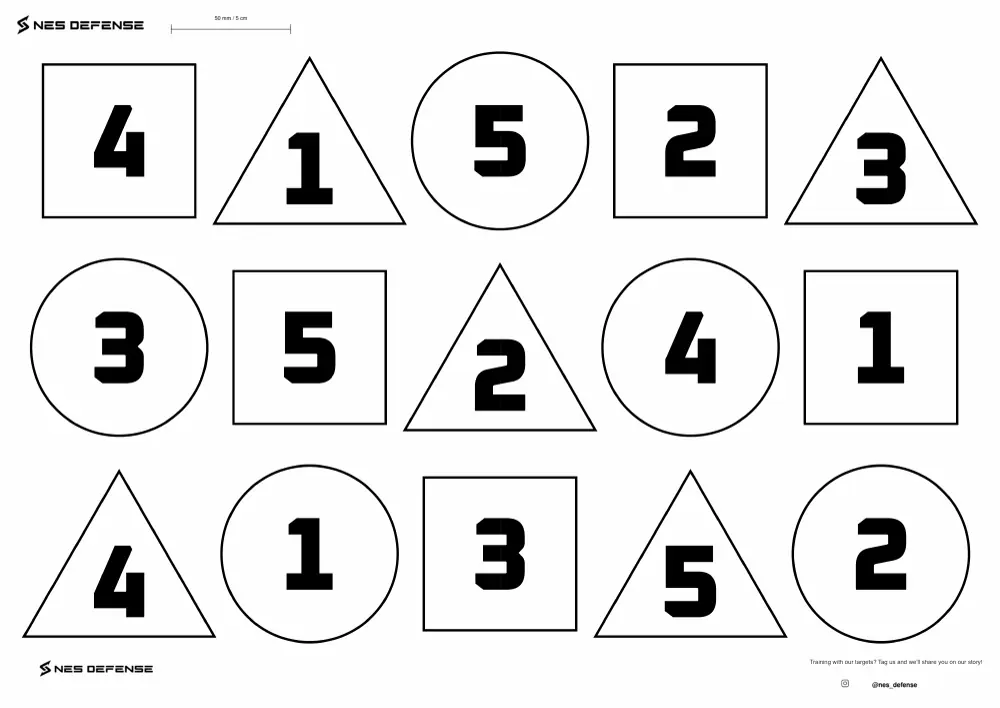
Decisions on top, also from concealment: called targets on Numbered Shapes, a shape and a number on each signal (alone, you prepare a card of calls in random order). Then the Bars & Cones by count, follow-up strings on the Triple Silhouette after another start signal, and a faster rate of fire on the 3-Zone Figure. DIAMOND opens with the Focus Squares.
PRO 150 rounds · DIAMOND 200
Rounds in each LEVEL 1 session, reserve included, as each plan states them
Track
Technical session
Combat session
Combined session
A month
CORE
100
100
Not in CORE
Up to 200
PRO
100
100
150
Up to 350
DIAMOND
150
150
200
Up to 500
In every session, on every track
At least 6 meters (7 yards) to the target, and the plans let you add distance as your level allows.
A dry stage first: 5 to 15 reps of each sequence before any live round.
At least 10 rounds held in reserve to re-shoot a weak string, so one bad string never eats into the planned ones.
A session summary with the rounds for every stage, so you know what each string costs before you load.
Want to try the method before you buy? Our free pistol drills come from the same LEVEL 1 plans. On days you can’t get to the range, dry fire training at home keeps your grip, sight picture and trigger press sharp, with no holster work. Follow the full safety protocol every time: unload the pistol and check it twice, put all ammunition in another room, loaded magazines included, point only at a backstop that could stop a bullet, keep live ammunition out of the whole session, and reload only after it ends, once you have said out loud that practice is over.
Every level is one month. All four lead here:
What changes from LEVEL 1 to LEVEL 4?
LEVEL 11/4
CALIBRATION
Start from facts.
Month one measures where you really start, from the ready position and from concealment, so you know which gaps the next three months have to close.
LEVEL 22/4
CONSISTENCY
Hold it on an ordinary day.
The same clean result, string after string, including on the days you are not at your best.
LEVEL 33/4
PERFORMANCE
Add pressure.
The demands rise on the same skills, so you learn which of them hold when you have to push.
LEVEL 44/4
INTEGRATION
The whole job, end to end.
What the first three months built comes together as one sequence, measured against the NES STANDARD.
Who is this for, and who should pick a live course instead?
NES is for armed citizens who already shoot safely and want a plan. A live course is for anyone who needs an instructor first, or wants what only a live course can give.
NES fits you if:
You carry a pistol, or keep one for your family's protection, and want skill you can measure rather than a certificate.
You already handle a pistol safely and can shoot at your range on your own.
Your range allows holster work and faster strings, and you can get there 2 or 3 times a month.
You want to keep training for 4 months, not for one weekend.
Pick a live course instead, or first, if:
Holster work is new to you. Have a qualified instructor teach it in person.
You want force on force, scenarios, low light or a shoot house.
You want rifle work, team tactics or room clearing. NES is pistol only.
You need a permit, a CCW class or a certificate. NES gives none of them.
4 levels that build on each other, with a clear printable plan for every session.
02
A dedicated target set for every session
So every drill, every round and every metric is tied to a clear goal.
03
Measurement and tracking all the way through
So you know where you stand, what improved and what comes next.
04
Access to your own member area
Where you download the training plans and targets for every stage of the program.
A note on language: the printable plans and targets are in English. Each session also has a short training video, and for now those videos are in Hebrew. English videos are on the way.
Plus 2 bonuses: a month of coaching support and NES MEMBER for life
What do people ask about civilian tacticaltraining?
Six short answers on special forces, experience, online delivery, gear and range rules, live classes and permits.
No. It is not a special forces course or selection, and we won't sell it as one. The NES programs were built together with Israeli special forces operators with combat experience, but what you run is a civilian pistol program: no rifles, no team tactics, no room clearing, and no operator at your lane.
What you get is the structure built with them: dry work before live fire, every round planned, strings on a start signal and targets that make you decide.
You need safe gun handling and a range where you may shoot on your own. No tactical background is needed: LEVEL 1 CALIBRATION measures where you start.
If holster work is new to you, have a qualified instructor teach it in person before your first combat session, because those sessions are shot from concealment.
Only the delivery. You download each session's plan and targets from your member area, and each session comes with a short video. The plans and targets are in English; the videos are in Hebrew for now, with English versions on the way.
All of the shooting happens at a range.
Per the plans: your pistol, 3 magazines, your everyday carry holster, a magazine pouch, and the printed targets for that session. Eye and ear protection come on top, every time. You shoot from at least 6 meters (7 yards).
Before session one, check with your range: every session includes holster work, at least in its dry stage, and the combat and combined sessions add faster strings from concealment. Many ranges limit both, especially indoors. The range's rules always come before the plan.
Yes, and the two fit well. A live class gives you coaching and pressure from real people; NES gives you a written session for each range day in the months that follow.
If you are new to holster work, take the class first and start LEVEL 1 after it.
No. NES gives you no permit, license or certificate, so it can't serve as proof of training for any state's carry permit.
It teaches shooting skills, not law. For the law on carrying and self-defense, rely on your state's official sources or a qualified attorney.
Where do you start?
With the pistol you already carry. Choose the track that matches your monthly round count, then take session one to your range. LEVEL 1 shows you where you stand, and every session after it builds on that.