

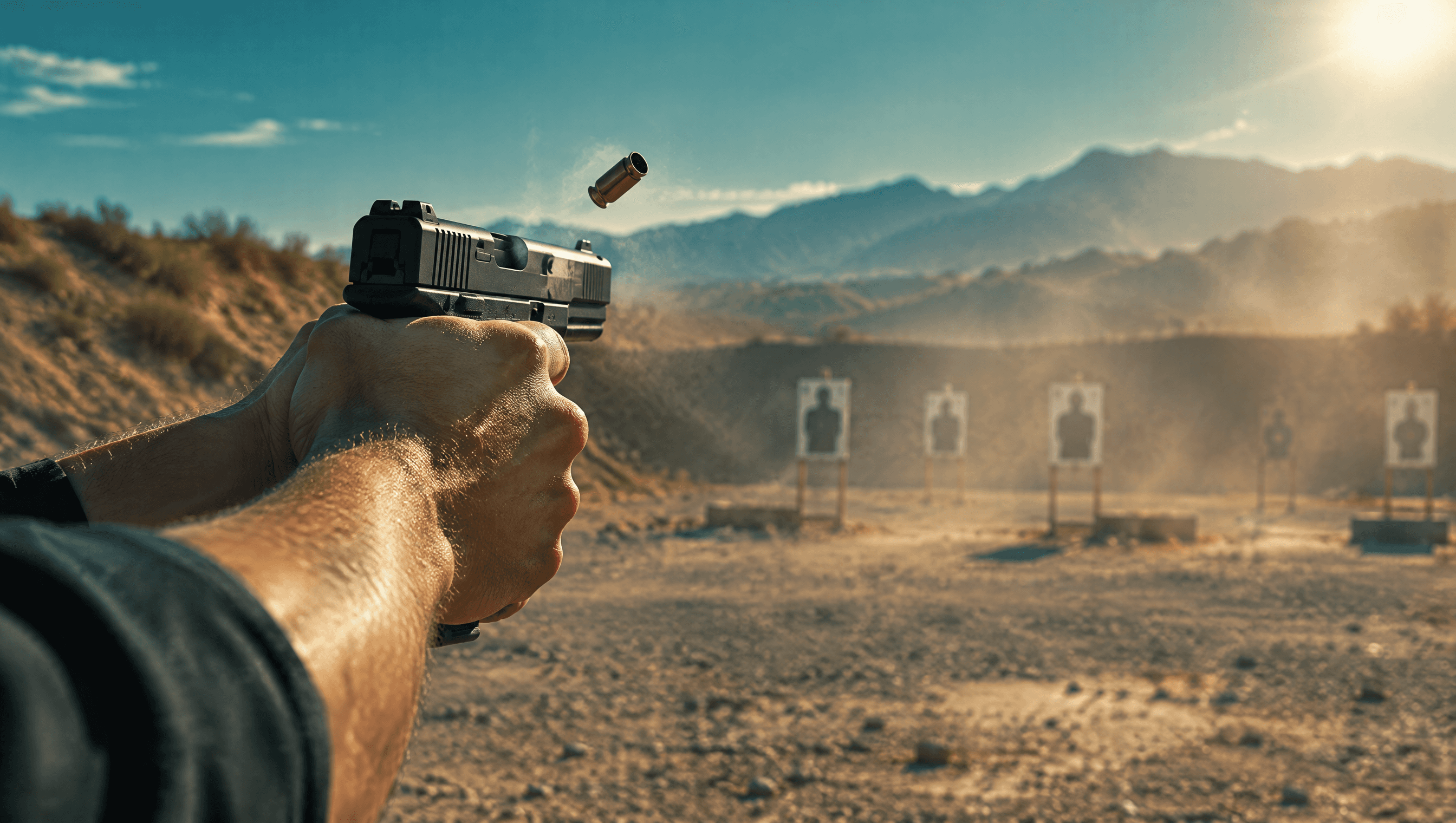
Stress makes almost every shooter worse, professionals included. In the best-known data set, New York City police officers hit 18% of their shots in gunfights where the suspect fired back. A range lane lets you shoot a still target at your own pace; a real confrontation takes away the time, the calm and most of your attention. The numbers below show how much, and which parts of it you can actually train.
How accurate are trained police officers under fire?
Far less accurate than most people expect. A 2008 RAND review of NYPD firearm discharge reports from 1998 to 2006 found that officers hit 18% of their shots in gunfights, 30% when the suspect did not fire back, and 37% at 7 yards or closer. PolitiFact's review of police hit rates puts those numbers next to other departments: the LAPD averaged a 33.4% hit ratio from 2012 to 2016, and a 2006 review by researcher Michael D. White concluded that hit rates vary across agencies but rarely exceed 50%.
These are people who qualify with their pistols on a schedule. Most of their rounds still missed, and when someone was shooting back, more than eight in ten missed. That is not a knock on police training. It is a measurement of what stress does to anyone holding a gun, and it applies to private citizens at least as much.
What happens to your body during a shooting?
Your perception changes in ways you cannot switch off. Psychologist Alexis Artwohl surveyed 157 officers from several agencies who had been involved in shootings between 1994 and 1999, and published the results in the FBI Law Enforcement Bulletin, October 2002. The officers reported:
- 84% heard sounds as diminished
- 79% had tunnel vision
- 74% responded on "automatic pilot," with little or no conscious thought
- 62% saw the event in slow motion, while 17% felt time speed up
- 52% lost memory of part of the event
- 46% lost memory of some of their own actions
- 39% felt dissociation, a sense of detachment or unreality
- 21% had memory distortion: they saw, heard or experienced something that did not happen, or happened very differently
- 7% reported a moment of temporary paralysis
Each of these is a practical problem. Tunnel vision means you may not see a second person, or what is behind the person in front of you. Diminished hearing means you may not hear your spouse, or an arriving officer giving you commands. Slow motion can make you feel you have time you do not have.
Why does "automatic pilot" matter most?
Because it tells you what you will actually do. When three out of four officers act without conscious thought, the brain falls back on whatever it has repeated most often. If you have done a thousand clean draws, a clean draw is what shows up. If your practice is a few relaxed range trips a year, the gun already in your hand and no clock running, you honestly do not know what shows up.
An old saying in training circles puts it simply: under pressure you do not rise to your expectations, you fall to your level of training. The Artwohl survey is about as close as anyone has come to measuring it.
Does a tight group at the range mean you are ready?
No. A tight group proves you can shoot well in ideal conditions: standing still, no time limit, no decision to make. That is the foundation, and it is only the foundation.
Many owners never get past it, or never get to it. In a 2015 national survey, 39% of US gun owners had never had any formal firearms training, and the training people did get most often covered safe handling (61.1% of trained owners), not shooting under pressure (Joyce Foundation summary of the Injury Prevention study).
How do you train for stress at the range?
You add the pressures a static lane leaves out, one at a time. No range can recreate a real threat, and no honest program claims to. What you can train is the part you control:
- A clock. A shot timer or a par time changes everything. The draw that felt smooth snags on the cover garment and the grip does not seat. Better to find that out against a timer.
- A choice. Targets with numbers or shapes, and a call before each string, so you have to find the right target before you press. Most shooters are trained to press, not to choose.
- Concealment. Your carry gun, your holster and the clothes you wear every day. If you never practice clearing the garment, you will not do it cleanly when it counts.
- Changes of pace. Fast strings, then slow precise ones, so you learn which speed each shot needs and keep your hits as you push.
- Surprise stoppages. Have a training partner mix a dummy round into your magazine so the malfunction arrives when you are not waiting for it, and clearing it becomes a reflex.
Many indoor ranges restrict holster work and rapid fire. Ask before your session, look for a bay or an outdoor range that allows what you need, and never break a range rule to finish a drill.
Can you practice for stress at home?
Partly. Dry fire builds the repetitions that automatic pilot draws on, and it costs nothing but ten minutes. Unload the gun and check it twice, take all live ammunition out of the room, and point only in a safe direction. Then rehearse the full sequence: clear the garment, grip the gun in the holster, draw, present, dry press on a full sight picture. Start slow, 5 to 15 clean reps, and add speed only when the slow version is perfect. Dry fire cannot teach you recoil, so it supports range time and never replaces it.
What should you take from these numbers?
That they apply to you too. Adrenaline will narrow your vision and cost you accuracy no matter how you train. What training changes is what your hands do while your mind is busy, and the only method that works is repetition under conditions as close to real as your range allows, measured so you know the skill holds. If you are wondering how often that repetition should happen, we covered it in how often you should practice shooting.
NES was built for exactly this gap. The tactical firearms training sessions make you draw from concealment, work on a clock and change pace, with called targets on the higher tracks, all at your own range with a printed plan and dedicated targets. If you carry daily and want the full 4-month path, see the concealed carry training program. It is not an instructor-led course, so if you have never drawn from a holster, learn that from a qualified instructor first.