

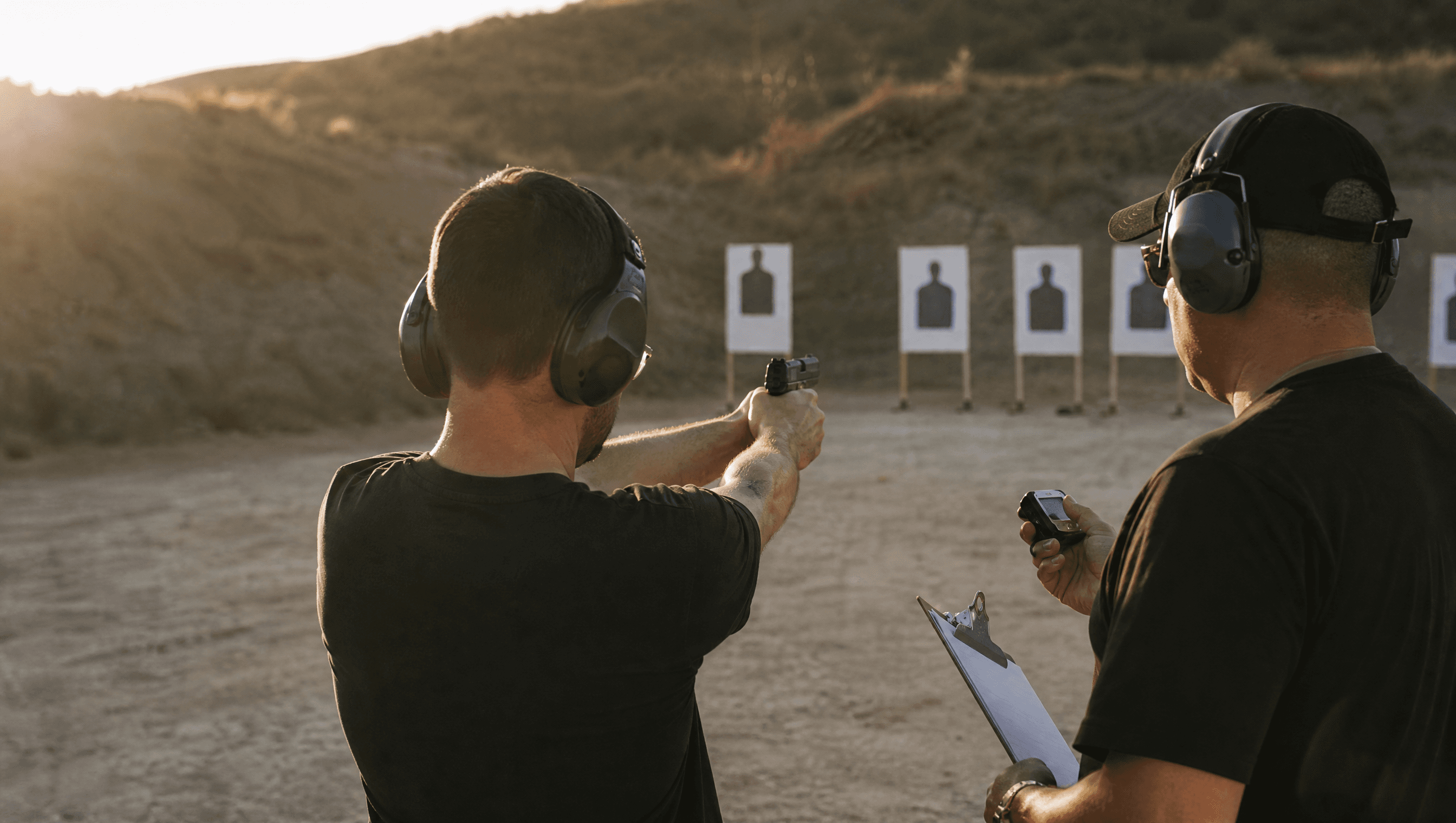
For most people who carry or keep a handgun for protection, a realistic answer is two to three focused range sessions a month while you build your skills, at least one a month to keep them, and a few short dry-fire sessions at home in between. What you do in each session matters more than how many you book. And since permit rules set a minimum to get a permit, not a practice schedule, how often you train is entirely up to you.
Does your state require any practice after the permit class?
Permit rules set a minimum to get a permit, not a practice schedule. Texas, for example, requires 4 to 6 hours of classroom instruction plus a live-fire proficiency demonstration for a license to carry (Texas Government Code 411.188). Some permit states require no training at all: ConcealedCarry.com's state-by-state table, reviewed in September 2026, lists Alabama, Georgia, Indiana, New Hampshire, Pennsylvania and Wyoming among them, and notes that Utah's class is about 4 hours of classroom only.
In 29 states, home to 46.8% of Americans, you do not need a permit to carry at all, according to the Crime Prevention Research Center's 2025 report (summarized by NRA-ILA). For millions of carriers, nobody will ever check whether they can shoot.
How often do most gun owners actually shoot?
Not often. In a Pew Research Center survey published in 2017, only 13% of gun owners said they go shooting or to a range often. 40% said sometimes, 30% rarely and 18% never (Pew Research Center). In the same survey, 26% of handgun owners said they carry all or most of the time. Put together, a lot of people carry a gun every day that they fire a few times a year.
Shooting is a perishable skill. Grip, trigger press and the draw all drift without practice, and you rarely notice the drift until a timer or a target shows it to you.
How many range sessions a month do you need?
Here is the schedule we recommend:
- Building phase, 2 to 3 sessions a month. For the first few months after your permit, after buying a new carry gun, or after a long break.
- Maintenance, at least 1 session a month. Once the fundamentals hold, with the same test drill each time so you can see if anything is slipping.
- Between range days, 2 or 3 dry-fire sessions a week. 10 to 15 minutes each is enough.
These are not magic numbers. Someone who trains once a month with a written plan will improve faster than someone who goes every week and empties magazines with no goal. Consistency and content beat volume.
How many rounds? About 100 is plenty for one focused session. A technical session at the first level of our program, for example, uses 100 rounds: 86 planned and 14 held in reserve. Two sessions like that come to 200 rounds a month, which is a realistic ammo budget for most people.
What should one range session include?
One focus, a clock and a score. A one-hour session can look like this:
- Dry warm-up, 0 rounds. Where your range allows it, 5 to 15 reps of grip, presentation and a dry press on a full sight picture before you load.
- Fundamentals at close range. Slow, precise strings at 7 yards to check that your grip and trigger press are clean today.
- One topic. The draw, reloads or clearing malfunctions. One per session, not five.
- The same drill on a timer. This shows whether what worked slowly holds when you speed up.
- A fixed test drill at the end. The same drill every session, scored and written down.
- Reserve rounds. Keep 10 to 15 rounds back to re-shoot the string that went wrong, so you fix it the same day.
Holster work and rapid fire are restricted at many indoor ranges, so ask first and follow the range's rules.
What can you practice at home between sessions?
Dry fire, done safely, covers most of the mechanics. The rules are simple and not optional: unload the gun and check it, keep all live ammunition out of the room, and point only at a safe backstop. When you finish, say out loud that you are done, and do not take "one more rep" after you reload.
Good dry-fire drills:
- Grip and presentation, building the same grip every time
- A dry press on a full sight picture, watching that the front sight does not move
- The draw from your real holster and cover garment
- Reloads with empty magazines
Dry fire cannot teach recoil or recovery between shots, so it supports live fire and never replaces it.
Why write every session down?
Because what you do not record you cannot measure. After each session, note the rounds you fired, what you worked on, the score on your test drill and what broke. After three months you will see a trend, and that trend is what keeps people training. It also keeps your ammo budget honest.
What should the first month after your permit look like?
Short and deliberate. In week one, review the safety rules and your state's carry laws from official sources, and set up a safe dry-fire spot at home. In week two, book a short first range session with one focus. If you have never fired a handgun before, take an in-person basic class with an instructor first. In weeks three and four, do a second session and shoot the same test drill again. Then keep to 2 or 3 sessions a month for the next few months before settling into at least one. If you want to know where a first class leaves you, read what a beginner pistol course will not teach you.
The NES pistol training program is built on this rhythm: 4 months, 2 or 3 range sessions a month at any range, each with a printed plan, dedicated targets and a standard to hit, from LEVEL 1 to LEVEL 4. You pick a track by how much you shoot (CORE up to 200 rounds a month, PRO up to 350, DIAMOND up to 500). There is no instructor at your lane, and the session videos are in Hebrew for now, while the plans and targets are in English. If you carry every day, the concealed carry training program shows how the same tracks train you from concealment.